
Become a confident public speaker.
Built by a World Public Speaking Champion to teach you the techniques great speakers use.
Short interactive lessons, custom daily challenges, and personalized AI coaching that reviews your recording and tells you exactly what to work on.

Learn it. Say it. Get coached.
Most apps stop at videos and quizzes. This one makes you actually speak, because that's the only way anyone gets better.
Learn one technique
A short, interactive lesson on how to open a speech, tell a story, or hold a room. You answer as you go, so it sticks.
2–3 minutes · 128 techniques across 12 skills
Say it out loud
Record a 1–3 minute answer to the day's prompt. No audience, no judgment. Your practice stays private on your phone.
A fresh prompt every day · builds your streak
Get specific coaching
The AI watches your daily recording and gives you a score out of ten, written notes on five parts of your speaking, and one clear next step. Want to go further? Unlock a Deep Review.
Never a vague "be more confident"
Your first lesson, right here.
Thirty seconds, two questions. By the end you'll spot something in every speech you hear this week.
Standing ovation.
You just learned to see what most speakers never notice, in under a minute. There are 127 more techniques where that came from.
Real screens. Real lessons.

One path, 128 techniquesLevel up from foundations to mastery

Coaching that gets specificClarity, pacing, vocal variety, body language

Frameworks that stickLearn the moves great speakers rely on
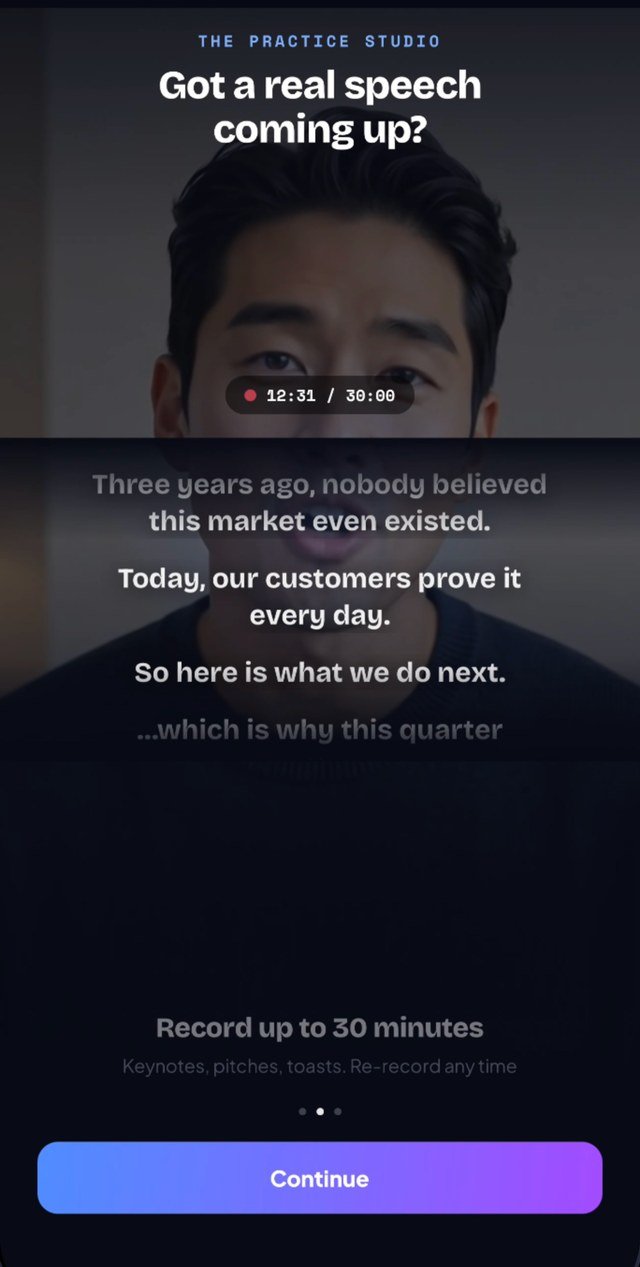
Your private studioTeleprompter, camera, up to 30 minutes
A coach who watches the whole take, and tells you what it saw.
Finish the day's challenge and you get a score out of ten, written notes on five parts of your speaking, and one next step to try tomorrow. The feedback system was curated by a world public speaking champion, so every practice session gives you a chance to get world-champion-level feedback on your presentation skills.
Want the full picture? A Deep Review is a complete written coaching session: a coach summary, a verdict on the assignment, a written scorecard across every part of your delivery, a detailed report, and the exact moments that helped or hurt. Reading about speaking is like studying swimming on dry land. This is where you get in the water, privately.
Opening on "I almost quit that night" pulled us straight in.
Your voice dropped on the hard moment, and it made us feel it.
Clear throughout, but you sped up right before your main point.
Steady eye contact with the lens, and your posture stayed open.
You told the story but didn't say what it taught you.
What a Deep Review looks like
Record a take and your coach writes you a complete review. Here's an example of one.
Deep Reviews use gems. Pro includes 600 gems a month, about 24 reviews. Gem packs never expire.
Your strongest open yet. You dropped us straight into the story. Now make the ask as deliberate as the setup: you rushed the one line that mattered most. Fix that single beat and this goes from good to memorable.
The brief was to open in the middle of the action, with no preamble, and you did. You dropped us into the 2 a.m. moment and earned attention in the first breath. To fully land it, carry that same urgency into your ask instead of easing off.
Crisp and easy to follow. Every word carried to the back of the room.
Steady once you settled; the first ten seconds ran a step ahead of you. Breathe before you begin.
Real lift through the story beats. Don't let the numbers flatten you back out.
Open and grounded. Your hands reinforced the point instead of fidgeting.
Locked to the lens for most of it; your eyes dropped on the ask. Hold it there.
Three "um"s, all in the setup. They vanish once you find your rhythm.
Clean arc: setup, turn, ask. The bones are right.
Here's the full picture. Your instincts on the open are excellent. You trust the story and let it carry the weight, which is exactly what most speakers are too nervous to do. Where you lose a little is the back half: as you move toward the ask, your pace climbs and your tone levels out, so the most important line arrives with the least weight.
Next take, change one thing: put a full second of silence before the ask, drop your pitch, and hold the lens. That one adjustment makes the close feel as deliberate as the open, and the whole piece reads as one finished, confident take.
This feedback is private to you and isn't shared with friends.
A speech is never wrong for lacking a technique. It's wrong when it fails to move a listener.
- 01Move the room, not a checklist.
Every lesson is judged by one standard: does it land with a listener? Technique only counts when it changes how the room feels.
- 02Ready when you're put on the spot.
Most of the speaking that matters isn't a speech. It's being asked for your view in a meeting, the question you didn't see coming, the "could you say a few words?" So every day you get a fresh prompt and no time to script it. That's how impromptu champions train, and it's how you learn to stop freezing.
- 03Practice in private. Hear the truth.
Nobody sees your practice unless you choose to share it. And the coach won't flatter you. It only comments on what it actually saw and heard, so when it says something worked, you can believe it.